
How far has this gold nugget traveled? | Mine Letter

MINE LETTER / NOVEMBER 9, 2026
Suppose you found a flat piece of gold in the bottom of your pan. Would you walk upstream looking for the rock it came from? How far would you go before you started to think you'd passed it?
In the Klondike, geologists got a rare chance to work that question backward. They had gold from the bedrock, gold from the creek gravels, and a way to compare the two. Their results explain why prospectors pay attention to worn edges. They also explain why we'd hesitate to put a mileage figure on any nugget in a collector's tray.
What changed in the first five kilometers
In 1999, researchers published a study of about 2,700 gold particles from 21 bedrock deposits and 36 placer deposits in the Klondike. A placer is an accumulation of minerals in loose sediment. As the team compared particles along their routes from the source, two changes stood out. Corners grew rounder and particles grew flatter. In their samples, both changes were fastest in the first five kilometers. Farther downstream, they continued more slowly. Read the original Klondike research in Economic Geology.
Round and flat sound similar until you hold two pieces of gold. A chunky nugget can have softly rounded corners and still feel thick between your fingers. A flake can be broad enough to cover the same patch of your palm and all but disappear when you turn it edge-on. The researchers attributed much of the flattening to repeated impacts in moving gravel. Rubbing against other material had its clearest effect on surface texture.
There's a wrinkle. In a separate study of New Zealand rivers, researchers found that coarse pieces could lodge in bedrock cracks. Farther downstream, where gold had flattened into thin particles, some edges folded back over. A flake that folds becomes thicker again. Two pieces recovered side by side can have very different histories by the time they reach the same pan. See Youngson and Craw's 1999 river study.
That's where the fieldwork earns its keep. A team with dozens of sampling sites can trace a pattern downstream. Buying a single nugget, you usually have photographs and a locality. Here's how we'd use them.
What to look for in two nugget photos
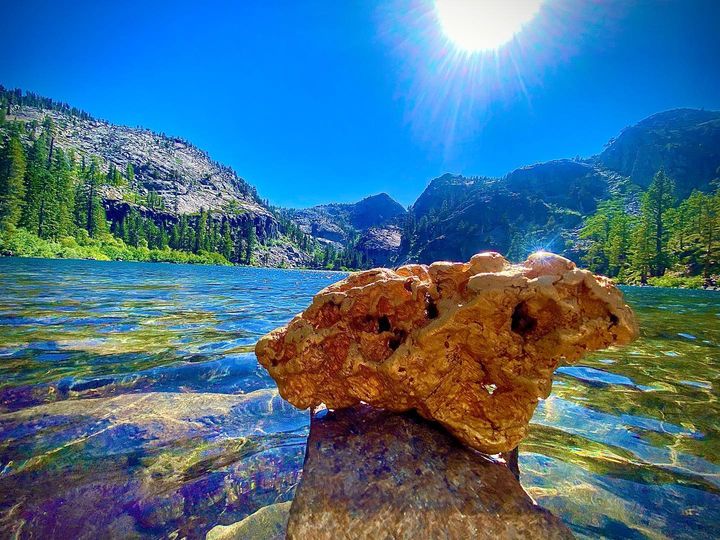
Take the Australian gold nugget on our cover, No. 1203. In the close-up, find the deep notch on the lower edge, slightly left of center. Follow it up to the narrow bridge of gold above it. Now find that pair of features in the photograph beside the quarter. The nugget has turned, but the notch and bridge still fit together. Your eye can follow the same piece across both views. See the original photographs of No. 1203.


Next, look at the high shoulder at the right of the cover photo. Its outside edge curves gently. Just below it, the outline cuts sharply inward. Calling the whole nugget either "smooth" or "rough" would lose the feature that gives it much of its character. If you like the broad face and want to know how substantial it is, ask for its maximum thickness in millimeters or a photograph taken level with the edge. The quarter gives you scale across the face. An edge view answers how the piece would look standing up in your display.
For its specimen card we'd write, Australia. No. 1203. 25.45 g total. Elongated outline with a deep notch below a narrow bridge. That's a description another collector could check against the piece. A creek name, recovery date or distance from bedrock would take a record from the field. If the seller has the original finder's label, ask to keep it with the nugget.
What a name on a creek record can tell you
Birch Creek in Alaska's Circle Mining District offers a reason to save those firsthand accounts. The Alaska Miners Association credits Pitka Pavloff and Sergei Cherosky with finding gold in paying quantities there in the summer of 1892. Under the citizenship rules applied to them, the two men could not hold federal mining claims. Later histories often credited men who found gold in the district a year later. Pavloff and Cherosky were the announced honorees for the November 4 History Night in Anchorage. The Alaska Miner's fall account and the convention program.
For a collection, there's a practical distinction here. A claim document can name the claim holder. A note from the person who lifted a nugget from the gravel can name the finder and the spot. Copy what each source actually records. Years later, when someone asks where the piece came from, that little slip of paper may be the only way to answer.
The week in gold, November 2-6
The London morning gold benchmark rose $89.25 per troy ounce, or 2.24%, between the Friday auctions on October 30 ($3,981.10) and November 6 ($4,070.35). Both LBMA Gold Price AM auctions began at 10:30 a.m. London time, GMT on both dates. The same series went from $3,896.85 on Monday to $4,123.65 on Thursday. After Friday's morning auction, stronger U.S. payrolls lifted the dollar and Treasury yields, and Reuters reported that gold came under pressure later in the session. Westmetall daily prices, LBMA auction times and Reuters, November 6.
On November 5, Governor Adam Glapinski said the National Bank of Poland had reached its 700-metric-ton gold reserve target and left further purchases open. Most of the gold was then in London. His long-term plan called for equal shares in Poland, at the Bank of England in London and at the Federal Reserve Bank of New York. A planned vault in Warsaw would help Poland accommodate its share. Reuters via Kitco, November 5.
When comparing two nuggets, use the market quote for the fine gold content where that content is known. The total grams on a specimen card can include other metals and attached stone. For the collector portion of the price, compare pieces of similar size, form, condition and documented origin. On No. 1203, that narrow bridge is worth a second look. If it's what draws you to the piece, ask for a clear view from the back. You'll learn something about the gold you're choosing, even if the distance it traveled stays a mystery.
Sources include Economic Geology, vol. 94 (1999), Alaska Miners Association, fall 2026 and November 4 program, Westmetall and LBMA, October 30-November 6 benchmarks, Reuters, November 5 and 6, and Nuggets by Grant specimen record and photographs, November 9.